
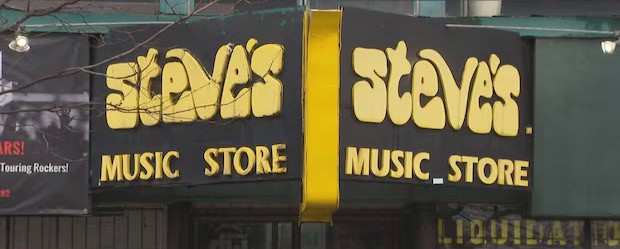
I walk down Queen West in Toronto regularly. I used to live there and I owned a retail store on Queen West for 15 years. I’m familiar with the clothing stores, shoe stores, candy shops, restaurants, fast food, and other outlets and can probably name what was in each location ten years ago. It is my humble opinion that Queen Street is Toronto’s best street; from East to West, it has everything.
Like retail everywhere over the last couple of decades, Queen West has seen more than its share of retail turnover. And not all stores today are flourishing – it’s obvious.
If someone were to come up to me and say: “I will hand you the keys and ownership of any business on that strip today – which would you take?”
Steve’s Music. Without hesitation.
Not because I’m a musician. Because I understood exactly what that business was: a place where the product cannot be separated from the experience of choosing it. You don’t buy a guitar the way you buy a sweater. You pick it up. You feel the weight. You play a few chords. You put it down and pick up another one. The instrument chooses you as much as you choose it. And someone who knows more than you guides you through the process.
That kind of retail is rare. It had been on Queen West for 50 years, and it is the kind of business you would expect to hold up better than most in an online world.
So, when I was driving along Queen West last week and noticed that the store had closed, I nearly smashed into a parked car as I rubber necked looking at the sign in the window.
How does a store like that close?
What Happened
The company entered restructuring proceedings. This is what was posted on Steve’s website:
“It is with a heavy heart that we have taken the difficult decision to undertake a formal restructuring. Over the past several years, we have operated in an environment marked by significant disruption across the sector. These changes had an immediate and negative impact on our performance. Despite various efforts to adapt, we continue to face mounting financial pressure, which, after reviewing all our options, ultimately led to the current restructuring proceedings.”
Four of its five locations closed. Only the Montreal flagship survived. Nearly five decades on Queen West, gone.
The easy explanation is online competition. And there’s truth in it. But it’s incomplete.
Despite e-commerce growth, recent market research suggests that most musical instruments are still purchased offline, with estimates generally landing in the 70% range. This is still a category where physical stores matter. Musical instruments are a tactile purchase. People want to hear them, feel them, play them, and compare them in person before they buy.
So if most instruments are still bought in stores, what happened?
The Accessories Problem
Here’s my theory. My guess is that the margin was never really in the guitars. It was in the accessories. The strings, the picks, the cables, the stands, the cases, the pedals, the practice amps. The stuff you buy again and again. The stuff with healthier margins and repeat purchase cycles. That stuff is now on Amazon. Next-day delivery. Competitive prices. No reason to make the trip. For many customers, the instrument is still an in-store purchase. The repeat accessory spend is much easier to move online. If the accessories were subsidizing the experience, if the store needed both to survive, then losing one eventually means losing the other. The guitar brings you in. The accessories help keep the lights on. Take those away, and you risk turning the store into a showroom that cannot support itself.
That is the theory I came up with. I may be wrong. Or I may be partially correct. If someone from Steve’s, or someone who knows the situation well, wants to explain what really happened, I would genuinely welcome it.
Of course, there are other possibilities. Rent may have become too expensive, the right staff may have been too hard to find, or the owners may simply have wanted to downsize and simplify.
It May Not Be the Market
Here is what makes me hesitate before blaming the market. Long & McQuade is opening new locations. People are still playing music. Downtown Toronto, with its musicians, students, and creatives, is not a place that simply stopped needing what Steve’s was selling.
The demand still appears to be there.
The Real Lesson
Steve’s had something that should have been hard to replicate online: expertise, atmosphere, and the experience of trying before buying. That advantage matters, but only if the business keeps giving people a reason to come in.
The stores that survive the Amazon era lean into what Amazon cannot do. They build communities. They run events. They host lessons, workshops, and jams. They become the place where musicians go, not just to buy, but to spend time, ask questions, and improve.
I do not know whether Steve’s did enough of that, or whether any of it would have changed the outcome. What I do know is that the retailers still surviving have found ways to make the physical experience worth the trip, beyond just having product on shelves.
The Thought Worth Sitting With
Queen West used to have a store where someone who knew everything about guitars would spend forty minutes with you, help you find the one that fit your hands, your sound, your budget, and send you home with something you’d play for twenty years.
That store is gone. That is a real loss for downtown Toronto’s musicians, students, and future musicians.
And I am not convinced it was inevitable.
The businesses we lose to online competition are not always lost on price alone. Sometimes they are lost because the experience was their real advantage, and over time they stopped investing in it. By the time that becomes obvious, the margin that once funded the experience is already gone.
The stores that survive are not always the cheapest. They are the ones that give people a reason to walk through the door.
Steve’s made people feel something. For nearly fifty years. That’s worth more than most businesses ever build.
The question, at least for me, is less why they closed and more what a business like that needed to do differently to stay essential, and whether the same risk exists in your own business right now.